

I have been hard for most of my life. Comprised of right angles, sharp bones, and often an even sharper tongue.
My first word was “f*ck,” I’ve been told (epic, I know), as a ball I was playing with rolled off the deck of our childhood home.
When my step-dad first met me, he worried my mom abused me, based on the myriad of bruises and scratches that covered my little body. It took him 5 minutes of watching unruly toddler June gravitate like a magnet to every sharp corner in the house to quickly dispel the concern.
I never crawled as a baby. I skipped straight to walking. A move my knees are paying for as I creep ever closer to 30.
Chaos and conviction have shadowed me through life.
Ballerina lessons, nope.
Gymnastics classes, nope.
Piano, hell no (6 years and 14 teachers before my parents finally gave up on this one, if that tells you anything).
I was rough. We would go to my aunt and uncle's house, and I would spend hours wrestling with my same-age male cousin until he caved and admitted defeat.
I was loud. Forever reprimanded for not using my “inside voice.” My stepmom, D, would literally charge me money from my petulant joke of an allowance for stomping around her house (and leaving lights on, and yelling, and incorrectly answering impromptu multiplication questions, etc.)
“Bull in the china shop” was a commonly used phrase as childhood play would inevitably end in a broken lamp or a cut knee. They laughed at me. They did not embrace me.
I was synical, catering to the masochism of my father in an attempt to garner his validation.
I made my mom cry; the angst and insecurity I bottled at my dad’s house (for survival there) would spill over into harsh words and unnecessary anger directed at my mom.
At 11 years old, I was dropped off at sleepaway camp for the first and only time. My mom’s parting words to me were terrifying: “Don’t leave your face like that, you look like a bitch. Smile.” And while I can’t disagree with her advice, it was probably warranted, that may not have been the best way to convey the message.
Nothing about me has ever been delicate, ladylike, or remotely soft. None of those qualities were innate, nor would they have served me well, but it didn’t take long for me to become supremely aware of how much space these qualities took up where there wasn’t any room for me.

for the version of you that wants to go deeper
2x monthly long-form essays
the full archive, from the very first word
(coming soon) free film print of the month
10% of every paid subscription goes to Girls Write Now.
I began to gravitate towards tall girls as my friends; they made me feel small, safe, and cared for.
Because I saw myself so dysmorphically, I felt larger than life. HUGE.
I became acutely aware of my presence wherever I went.
I started to compare myself to other girls for whom puberty was similarly striking, but, unlike for me, it looked elegant on them, draping their petite figures in soft curves and newfound length.
Comparison planted its seed in my eyes and grew to eclipse all clarity. It tangled with the reprimands of my youth…
Too loud
Too clumsy
Too emotional
Too sharp
Too much
Too much
Too much
And yet, somehow never enough?
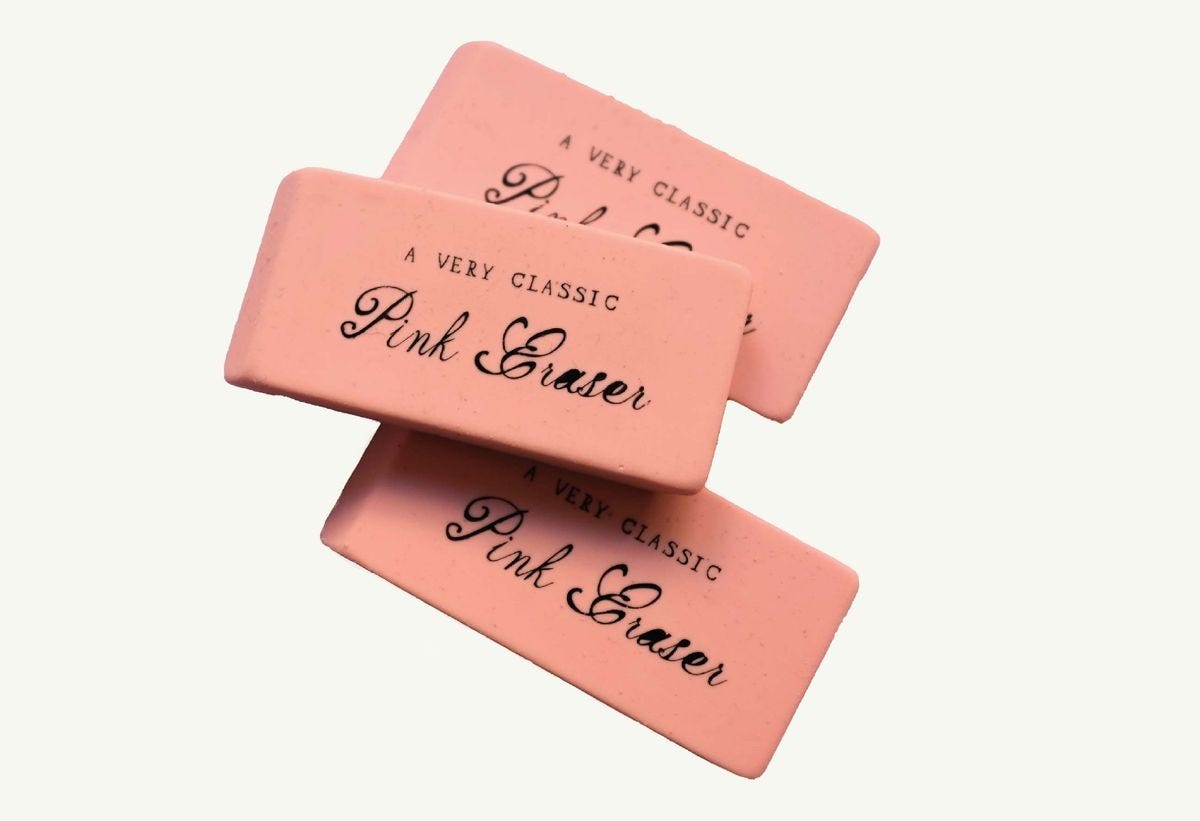
So I erased myself.
Not all at once.
Just little moments here and there where I chose to cloak my body, stifle my words, hide my feelings, defer my needs.
Like a chameleon, I took on just enough of those around me to cater seamlessly to whatever responses I intuited they coveted most.
In college, my friends would see me around campus and try to wave or say hi. But behind my ever-present sunglasses and noise-canceling headphones, their enthusiasm was for not.
I masked my shame and shrank my body until I could awkwardly squeeze into whatever space there was left to me.
But, much like shoving a square-edged peg into an organically shaped hole, there was friction and resistance. Imperfection barked at my aching angles. My hardness did not lessen as I ceased to exist.
If anything, it fortified as my color and joy drained, and all that remained was the hand-laid brick wall around my heart constructed in my youth.
Happiness and hope scared me. Unfamiliar as they were, they became forbidden fruit to my starving soul. I was the one who despaired, whose harsh sarcasm was good for a laugh or a leer behind the back of someone who no doubt deserved the biting criticism. I could protect and defend, but not nurture.
I knew how to hurt with my words; it was a rite of passage in my upbringing. Targeting vulnerabilities and using them as deflections against those who threatened my own.
